

















The Ultimate Guide to Understand Mobile First Indexing

Introduction to Mobile-First Indexing:
Before we begin, we must know the term ‘indexing’ itself. To generalize indexing means accumulating data and transforming it into special groups or lists in an organized way. Search Engines analyze text, images and videos from the zillions of websites online, and store this data to let you find information, by using keywords and phrases. This database is huge and therefore an index is required to facilitate easy and quick retrieval of the stored information, helping search engines efficiently google index large volumes of data. Learn more in our web development introduction comprehensive guide about how search engines work
Over the vast number of websites, Google performs indexing to catalogue fresh, valuable and information worthy websites that google would help users to find what they are looking for. Google crawler dynamically discovers and locates the best websites on the internet, and keeps the information organized and ready to be returned when a user performs a Google search for a specific keyword or phrase, enabling smooth web indexing and faster retrieval.
The term mobile first indexing emerges from within this dynamic process. Due to the growing number of mobile users, in 2016 Google algorithm was shifted to prioritize mobile versions of the indexed websites over Desktop or other formats. Later on it became the trend to follow a Mobile First Approach for web development, to be able to rank higher in Search Engine Result Pages (SERPs), especially when search engines index website content based on mobile performance.
Now that Google predominantly uses the mobile version of a website to crawl, index and rank it on search results, it has become evident to follow the same approach for web development. Mobile phones contribute to above 60% of the global web traffic. Google focuses on providing real world user behavior, and mobile-first indexing ensures search results align with how people browse the internet nowadays while improving how bots google crawl mobile pages.
Why Mobile-First Indexing Matters?
According to Statista, in January 2025 over 62% of the global Internet traffic for web page views came from mobile devices excluding tablets. This is why a website must be mobile friendly and prioritize serving pages for mobile-device users. Google by default favors mobile-first indexing for all new websites nowadays and hence poor mobile optimization can lead to lower SEO rankings and can deplete a website’s visibility. ultimately affecting how search engines index website pages.

This can further be broken down into three major points as below:
A.Brand Reputation:
A website that loads slow on mobile devices is perceived as unprofessional and people will not recommend a business with a poor mobile version of their website.
B. SEO Factor:
Google will ignore your website if it delivers poor mobile experience. And hence you will be outranked by your competitors with mobile-ready websites. If you do not have a mobile optimized website, Google will not include it in Featured snippets or Google Maps- 3 Pack, limiting your chances to google index effectively. learn how Google’s AI evaluates relevance in our article on what is RankBrain and how it impacts SEO and search engine rankings.
C. Mobile-First Audience:
Mobile devices have grown significantly, and people love to perform “Near me” searches with local intent on their mobile devices. Mobile users demand simplicity, speed, and seamless navigation at the tap of their thumb. A 2-second delay in load speed can put them off and skyrocket your bounce rate by 32%. As we all know, smartphones are so handy for making online purchases, and with Google’s mobile first indexing, content that’s optimized for mobile is prioritized in search rankings. You simply cannot ignore the large chunk of traffic originating from smartphones, as mobile-first indexing ensures that your mobile-optimized pages are more likely to rank higher in search results, ultimately driving more relevant traffic to your site and improving web indexing performance. Discover how we build user-friendly designs at Apex Digital Growth web development services
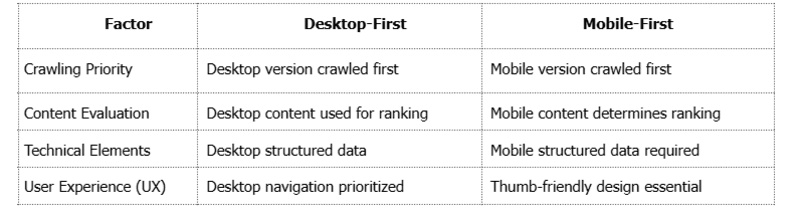
Key Differences Between Mobile-First and Desktop-Only Indexing:
Critical Considerations:
- Content Parity: Make sure that mobile and desktop versions have the same content (text, images, videos). Google won't load content that requires user interactions. Hiding content behind tabs or carousels on mobile can harm rankings and may prevent proper google crawl.
- Structured Data: Schema markup must exist on the mobile site.
- HREFLANG Tags: Crucial for multilingual sites to avoid indexing errors.
- Impact on SEO: If your mobile site is not optimized or has less content than the desktop site, your search engine rankings could be negatively affected and reduce your chances to index websites efficiently.
SEO Benefits of Mobile-First Optimization
- Google rewards mobile-friendly websites with better visibility
- Mobile optimized websites see up to 20% boost in organic traffic
- Increased chance of ranking in top 3 on Mobile SERPs
- Mobile responsive designs experience a low bounce rate and better web indexing

Technical Best Practices
The mobile-first design approach starts with designing the product for small-screen devices and progressively adapting it for larger screens. With Google's mobile first indexing, this approach ensures that your mobile-optimized content is prioritized for search rankings. Below are key points that must be kept in mind for mobile best practices:
A. Responsive Design
Why is it advisable?
The same URL can be used without the issue of duplicate content to stay aligned with SEO best practices and help search engines google crawl efficiently.
Key Elements:
- Fluid architecture with image resizing on devices
- CSS media queries for screen size adjustment
B. Speed Optimization
- Compress Images: Use WebP format and image resizing tools like TinyPNG
- Lazy Loading: Only load elements that are significant for the landing page
- Minify Code: Remove unnecessary code, spaces, comments, line breaks from CSS/JS
- AMP (Accelerated Mobile Pages): Mobile-first indexing can be useful if a website is optimized for mobile devices, but nowadays, it is crucial as Google prioritizes mobile-friendly content for search rankings. With mobile-first indexing, Google primarily uses the mobile version of a site for indexing and ranking, rather than the desktop version. As a result, websites must ensure that their mobile experience is fully optimized to perform well in search results and improve how pages google index.
C. Mobile-Friendly UI/UX
- Thumb-Friendly Navigation: Buttons and CTAs should be easy to tap (minimum 48x48 pixels).
- Avoid Intrusive Pop-Ups: Google penalizes “interstitial” ads that block content.
- Readable Text: Use a minimum 16px font size and high-contrast colors.
D.Technical SEO Must-Haves
- Structured Data: Test mobile markup with Google’s Structured Data Testing Tool.
- Canonical Tags: Ensure mobile and desktop URLs point correctly to avoid duplication.
- Mobile-First Sitemaps: Submit mobile sitemaps specifically to inform search engines about the URLs of your mobile-friendly pages or mobile-specific content, improving web indexing accuracy.

Common Mobile-first Pitfalls to Avoid
- Blocked Resources: Ensure CSS, JavaScript, and images aren’t disallowed in robots.txt.
- Slow Load Times: Aim for load time under 3 seconds by using CDNs and caching.
- Hidden Content: Hiding useful content under accordions or tabs will prevent the crawlers from indexing them properly during google crawl.
- Unplayable Media: Don’t use Flash as it can increase load time, many browsers don’t even play Flash content, so better to use HTML5 video players.
Tools to Audit Mobile Readiness
- Google Mobile-Friendly Test: Checks usability and flags issues.
- PageSpeed Insights: Analyzes speed and Core Web Vitals.
- Search Console Mobile Usability Report: Identifies crawl errors and helps monitor how pages index websites.
- Lighthouse: Audits performance, accessibility, and SEO.
- SEMrush or Ahrefs Site Audit: Compares mobile vs. desktop rankings.
Future Trends & Adaptability
- 5G Revolution: Increasing internet speed will raise user expectations for instant loading.
- Voice Search: 27% of global online users are using natural language queries to perform voice search on their mobile devices.As voice search becomes more common, especially with Google mobile first indexing, websites need to ensure that their mobile versions are not only responsive and user-friendly but also optimized for conversational queries and efficient google index handling.
- AI and Machine Learning: Google’s MUM (Multitask Unified Model) algorithm will prioritize context-aware mobile experiences. MUM can understand the context of queries, prioritizing the intent of a search query, and that's not just related to the direct query but also information that's contextually related. This aligns with Google's mobile first indexing approach, which prioritizes mobile-optimized content in search rankings and enhances web indexing.
Mobile first indexing is one of the critical things for ranking on SERP and for better traffic. The majority of the people are now browsing on mobile only, so it is important for you that your website is fast-loading, mobile friendly, and easy to navigate. By partnering with a skilled web design agency your site can be optimized according to mobile-first indexing. They can ensure that your website meets Google's standard criteria and deliver a seamless experience while improving how search engines index website content.
Justo Consulting, is a skilled web design agency, and helps brands in achieving their goals. Here our Web designers are well-experienced and create websites according to the need of the customer and fulfilling the advance criteria of google. Collaborate with us for affordable website design & development.
Conclusion
The final verdict is that mobile-first indexing is the cornerstone of modern SEO, and therefore the question that arises isn’t; “Is it within my means to optimize for mobile? However, it's "Can I afford not to?"
In this era of evolving internet technologies, Users demand fast, intuitive, and seamless mobile experiences, and Google rewards those who deliver. Mobile-first SEO is not just something to please Google but it is the precise strategy to future-proof your brand, build trust and to unlock growth within the right audience landscape.
Success in mobile-first indexing requires an overall approach to balancing technical optimization and to enhance the overall user experience. Mobile-first indexing requires a mindset shift—viewing every design choice, content strategy, and technical decision through the lens of mobile users first. The result is not just a responsive design or faster load times. It rewards you with improved SEO rankings and Core Web Vitals to higher conversions and brand loyalty, the benefits are undeniable.
If you’re a business owner looking for a professional website maintenance service, Justo Consulting LLC offers expert support in Web development, security updates, and performance optimization. Contact us today to keep your website in top shape by requesting a no obligation free consultation.